Skip to content

“Turned His Attention to the Land of Sudan”: Teaching the 1591 Conflict between Morocco and the Songhai

Discussion of teaching rivalries between states in world history

Bram Hubbell
Bram Hubbell
— 3 min read
“Turned His Attention to the Land of Sudan”: Teaching the 1591 Conflict between Morocco and the Songhai
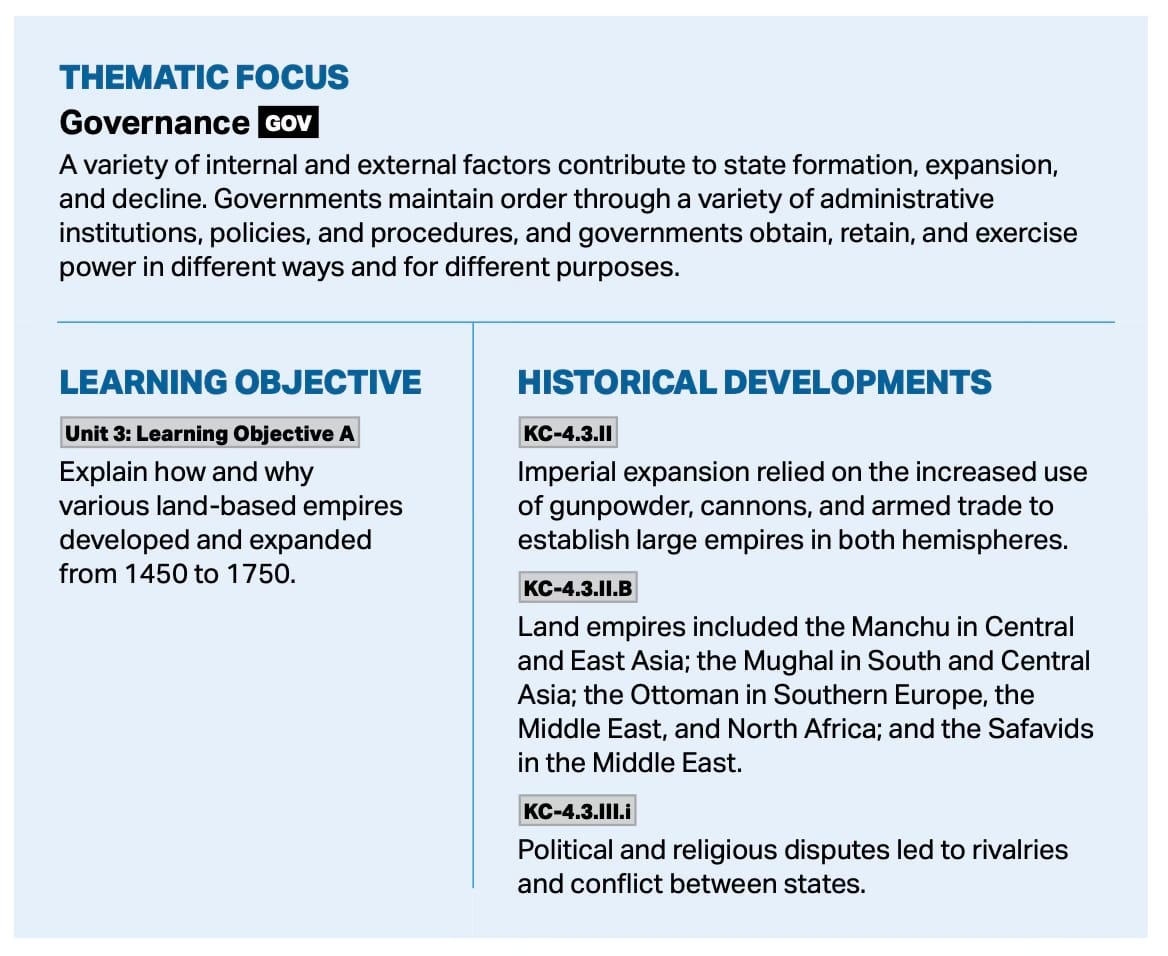
From page 69 of the AP World History Course and Exam Description

As empires expanded between 1450 and 1750, conflicts often occurred between states. Rulers frequently used different reasons to justify invading neighboring states. One of the conflicts textbooks tend to skim over is between the Saadian Moroccan Dynasty and the Songhai Empire in the late sixteenth century. This conflict occurred at the same time the Ottomans expanded up to the border of Morocco, and the Portuguese and Spanish pressured Morocco’s coastal cities. In this context, the Moroccans crossed the Sahara Desert and overthrew the Songhai Dynasty. The Moroccan army was smaller than the Songhai cavalry, but the Moroccans had gunpowder.

The Source


Related Posts

Members Public

“The Finest and Most Fruitful Country in the World”: The Importance of Agriculture in the First Global Economy

Teaching the Centrality of Agriculture to the First Global Economy

“The Finest and Most Fruitful Country in the World”: The Importance of Agriculture in the First Global Economy
Members Public

“Objects that Resemble the Ceramics of China”: Imitating Chinese Porcelain, c.1400 - c.1800

How potters around the world imitated Chinese porcelain in the First Global Economy

“Objects that Resemble the Ceramics of China”: Imitating Chinese Porcelain, c.1400 - c.1800
Members Public

“A Constant Succession of Flames and Smoke”: Jingdezhen, the Chinese Porcelain Industry, and its Global Appeal, c.1400 - c.1800

Visualizing the global popularity of Chinese porcelain in the First Global Economy

“A Constant Succession of Flames and Smoke”: Jingdezhen, the Chinese Porcelain Industry, and its Global Appeal, c.1400 - c.1800